
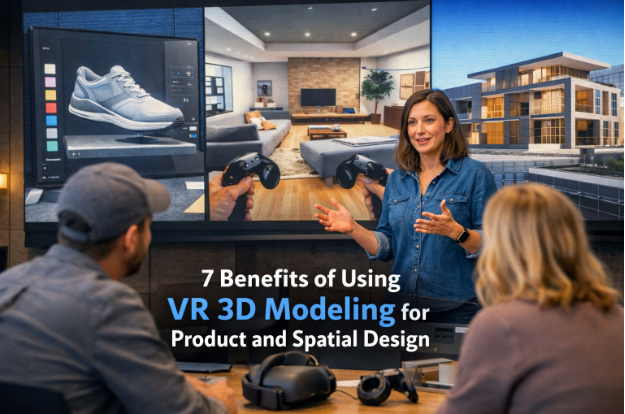

Product and spatial designing are increasingly getting more complex, and the wave of demands for greater accuracy, speed, and user experience is on the rise. Designers are not just expected to provide visual interpretations of their thoughts and notions, but they are also required to verify their notions, collaborate effectively, and reduce the number of revisions that are expensive. This has given rise to the use of VR 3D modeling.
Virtual reality alters the manner in which designers and others investigate and develop ideas through the ability to engage in immersive interactions in relation to concepts on a real scale. The following are the core advantages that justify the fact that the process of using virtual reality is giving rise to a radical shift in the design of products as well as spaces.
True-to-Scale Design Visualization
One of the most troublesome aspects of screen designs is that they can easily result in incorrect size perceptions. Sometimes, designs that look perfectly correct on the screen could look completely different in reality.
VR 3D modeling enables the designer to view the product or space in human-scale measurements from the very beginning. It is beneficial for proportion accuracy and ensures that the measurements or spacing of the layout feel right before proceeding.
Rapid Development of an Idea
The initial stages of design need speedy ideation. The classic development pipeline often cannot facilitate this because of countless render reviews.
Immersive environments provide the facility of real-time modifications in terms of form and layout. In addition, VR 3D modeling techniques provide quicker feedback and thus, quicker iteration without hampering the creative process.
Early Detection of Design Errors
Many of these are design problems that have not been identified until quite late in the process of development, when changes are very expensive in terms of time. The major design problems in this area are to do with scale, functionality, and flow.
By entering the design, problems are recognized at an early stage. Conflicts, poor proportions, or inefficient design arrangements can be detected before their implementation in construction or production.
Ergonomics
Flat designs cannot offer a correct assessment of the interaction between people and products or spaces. Indeed, when designs are analyzed at the conceptual level, the ergonomic aspect is usually ignored.
With virtual environments, designers and engineers are able to mimic real-world interactions with virtual models. This could include testing the accuracy of motion, reach, comfort, and visibility, which ultimately translates to user-friendly and functional models.
Stronger Collaboration Across Teams
Product design or spatial design may need to be done by several people with different knowledge levels. There may be communication problems, which could cause delays.
Immersive design reviews give everyone a common reference point that everyone can see and understand. In many cases, teams also rely on expert 3D modeling services so that environments inside the virtual world are correct and optimized for collaboration.
Less Dependence On Physical Prototyping
Physical prototypes are costly and take a long time to develop. Although they are still very useful during final verification, using them too early can be restrictive.
Virtual prototypes allow the testing and development of ideas to be carried out virtually. The amount of waste material is reduced, the costs are further lowered, and the process is accelerated without affecting the quality.
More Confident Decision Making and Approvals
Uncertainty leads to a delay in decision-making. This is due to the fact that, in the absence of a clear visual of the design, the decision process will take a longer period.
Immersive visualization eliminates that ambiguity, giving a clear idea about the look and functionality that the product or space is going to have. That gives people confidence, and teams can easily proceed without many changes.
Why VR-Based Design is a Momentum Gainer
More urgent timelines, greater accuracy, and integration of collaboration capabilities are fueling demands that lead designers to more interactive tools. The virtual reality solution has these features: addition of reality to interaction, which enhances the accuracy of design assessment.
Conventional work processes will not be adequate to keep up with the pace of current design requirements because the expectations will keep rising.
Conclusion
Right from conceptualization to final decision-making stages, many advantages of using VR 3D modeling apply to each step in the product as well as spatial designs. It is especially helpful in making designers smarter as well as more efficient.
By relying on dependable 3D modeling solutions, virtual reality would eventually transform from being an experimental platform into a scalable and feasible one. As various industries keep demanding increased accuracy with each passing day and with the pursuit of great user experience in mind, the need for design through VR ceases to be an option; rather, it’s on the cusp of becoming the norm with regard to quality design deliverables.